Foundations
Actuality
This article is still relevant because advice about building a "second brain" often begins with structure rather than use. Many note-taking systems promise clarity through categories, maps, and hierarchies. That can be useful, but it can also create a second job: maintaining the system that was supposed to reduce mental load.
The question is not whether structure is useful. The question is when structure starts costing more attention than it saves.
Thesis
A second brain should reduce cognitive friction, not create another layer of it. If a note-taking system requires you to remember a deep hierarchy before you can retrieve a note, then part of your attention is spent managing the system rather than using the knowledge.
My intuition is simple: the first brain is already good at association, pattern recognition, and rough recall. A note system should support those strengths, not fight them with premature formalization.
Core concepts
Three ideas shape this article.
Retrieval matters more than classification. A note is useful when you can find it at the moment you need it.
Categories are often clearer in hindsight. Many notes are easier to classify after they have matured, not when they are first captured.
Temporary material and durable knowledge should not be treated the same way. Daily fragments, sketches, and in-progress notes behave differently from long-term references.
Limits
This argument is not universal.
- Deep structure can be useful for research archives and large reference collections.
- Some domains benefit from careful taxonomy from the start.
- A flatter system can become noisy if nothing is reviewed or discarded.
The point is not that hierarchy is always bad. The point is that hierarchy is often introduced too early, before the scale of the notes actually requires it.
Implementation and examples
The usual promise of a second brain
A common model for personal knowledge management starts with a tree of life domains. Information is placed into top-level categories and then subdivided into increasingly specific branches.
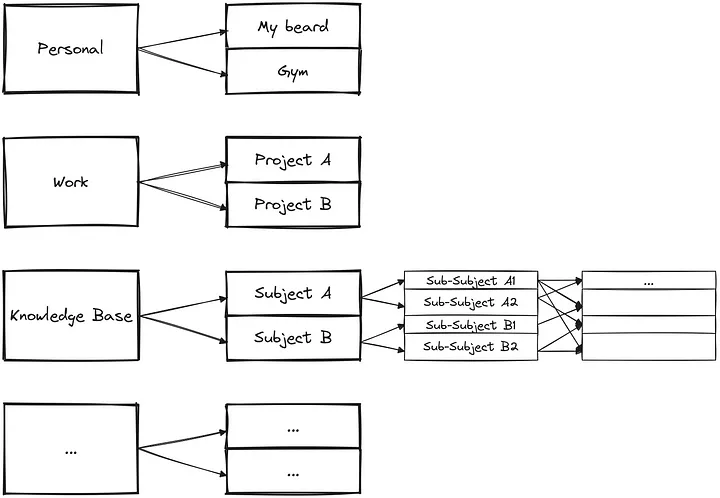
This is easy to explain and visually persuasive. It gives the impression that knowledge has been turned into a manageable system.
In some contexts, that is exactly the right move. If I were given a large batch of papers and asked to summarize or analyze them, I would absolutely use explicit categorization. Structured archives are useful when the primary task is analysis across a corpus.
The retrieval problem
The question changes when the system is meant to function as a personal second brain.
If the purpose of the system is to reduce mental load, then retrieval should feel close to the way memory already works: through associations, keywords, and partial cues.
For example, a deeply nested structure might look like this:
- Entertainment -> Video editing -> Final Cut Pro -> Production -> Colors
- Development -> Python -> Web frameworks -> FastAPI -> Authentication
These paths are logical, but they also ask me to remember the structure itself. To find one note, I may need to recall several levels of categorization before I even reach the information.
That is the hidden cost of an overbuilt system: you do not only remember the note, you also remember the management layer around the note.
By contrast, a flatter naming approach is often easier to retrieve:
- Final Cut Pro Production Colors
- FastAPI Authentication
Those note titles are closer to how recall often works in practice. A few strong terms are frequently enough.
The brain is already good at jumping from cue to cue. A note system should make that jump easier, not longer.
A flatter working model
Because of that, I prefer a much flatter structure for everyday notes.
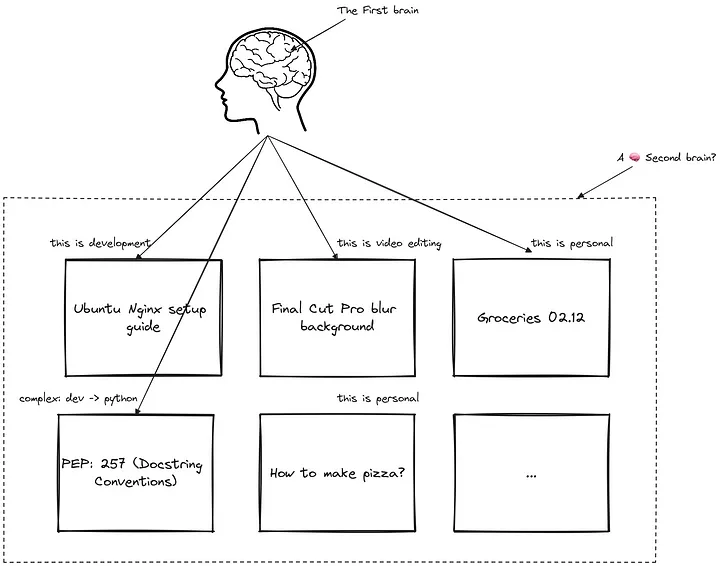
The idea is not to remove all order. It is to stop pretending that every new note already deserves a permanent place in a carefully designed tree.
Most notes begin as fragments: a task, a sketch, a problem, a partial solution, or a reminder. They are often too early, too messy, or too temporary for precise classification.
Unsorted and Vault
The model I find more useful has two spaces.
Unsorted. A place for in-progress notes, temporary fragments, project sketches, and short-lived material from daily work.
Vault. A place for notes that have earned a longer life and can now be labeled more clearly.
This is still a form of organization, but it delays categorization until the note has proved that it matters.
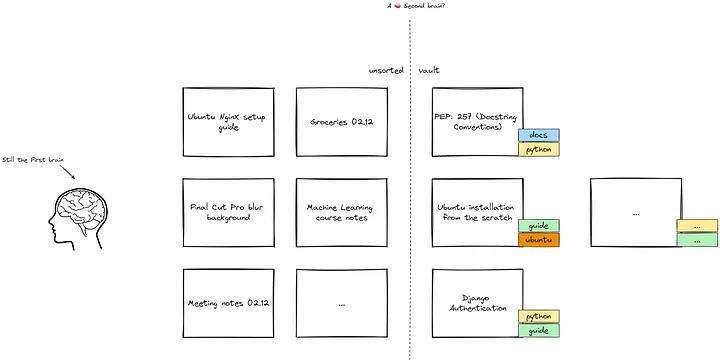
This solves two practical problems.
First, it respects the fact that most notes are not permanent knowledge. Many lose value within days.
Second, it recognizes that a note is often easiest to classify only after it has stabilized. The note becomes clear first; the label comes later.
How I use it
My daily routine produces many unsorted notes. Most of them are temporary: quick reminders, rough technical thoughts, incomplete project notes, or sketches made during work.
If a note stays useful over time, I label it and move it into the Vault. If it turns out to be noise, I delete it.
The same applies to project work. A project note can stay in Unsorted while the work is active. Once the project is complete, I can decide whether anything in it deserves to become a durable reference.
This creates a lightweight review cycle:
- capture quickly
- keep active notes visible
- review periodically
- preserve only what remains valuable
That is a very different mindset from building a full hierarchy in advance.
Tool choice
The specific application matters less than people often claim.
Use the tool that is easiest to open and use on the device already in your hand.
If you move between phone, tablet, watch, and computer, the ideal tool is usually the one that makes capture easy everywhere. A single app can still be helpful for simplicity, but the core principle is not brand loyalty. It is reducing the distance between thought and note.
Summary
The general idea is simple: do not build a second brain that ignores the strengths of the first one.
A useful note system should help you capture quickly, retrieve naturally, and postpone heavy structure until it becomes necessary. Categories are tools, not goals. The more energy you spend maintaining the map, the less value you get from the territory.
Recommendations
- optimize for retrieval, not for visual neatness
- avoid deep hierarchies until the scale of the material justifies them
- separate temporary notes from durable notes
- classify notes after they mature, not always at capture time
- review and delete aggressively so the flat layer does not become clutter
A second brain becomes useful when it stores what the first brain should not waste energy carrying, not when it turns note-taking into another system to memorize.