Foundations
Actuality
This article is still relevant if you are choosing a practical way to record family expenses and income when more than one person participates in the same budget. The project itself is a small personal tool, but the broader question remains useful: what interface makes collaborative budgeting easy enough to sustain?
The obvious options are familiar. The important difference between them is not only convenience, but how well they support collaboration.
| Option | Collaboration | Trade-offs | Best for |
|---|---|---|---|
| Paper notes | Nearly none; one person usually owns the record | Hard to share, search, or aggregate | Informal solo tracking |
| Local spreadsheets | Possible, but awkward without manual syncing | Weak multi-device use and unclear source of truth | One-person budgeting |
| Google Sheets | Strong baseline for shared editing and visibility | Spreadsheet friction remains; Google dependency | Family collaboration with low setup cost |
| Budgeting apps | Varies a lot; often designed more for individual use | Paid tools, heavy UI, uneven household workflows | Ready-made personal finance tools |
| Bank apps | Usually centered on one account holder, not a household process | Weak export, weak shared ownership, poor cash tracking | Bank-centered personal tracking |
This article is less about Telegram as a technology and more about reducing friction in a shared financial routine.
Thesis
A family budget system succeeds or fails on collaboration. If recording an expense is slow, awkward, or available only to one person, the shared record quickly becomes incomplete. For a family budget, the right tool is not the one with the richest reporting layer. It is the one that makes contribution simple for every participant.
That is why I ended up building a Telegram bot instead of continuing with spreadsheets or adopting a specialized finance application. In my context, Telegram was already the most familiar shared interface, so it reduced the cost of participation for everyone involved.
Core concepts
Three ideas shape the project.
Capture matters more than reporting. If data entry is annoying, later analytics do not matter because the data will be incomplete.
Shared access matters more than personal convenience. A family budget is not a private notebook. It is a collaborative record of household behavior.
Habit compatibility matters more than feature count. A simpler tool inside an already shared habit is better than a richer tool that only one person is willing to open.
Limits
This approach is not universally good.
- A self-hosted bot is harder to set up than a spreadsheet.
- It assumes Telegram is already part of everyday communication.
- It is a technical solution, so maintenance is part of the cost.
- It will not fit users who want bank-level automation or polished consumer-grade reporting out of the box.
The main trade-off is simple: lower collaboration friction in exchange for higher setup and ownership costs.
Implementation and examples
Why record financial changes at all
If you record both expenses and income, you gain something more useful than isolated numbers: a shared history of habits. Monthly and annual summaries make it easier to see where money actually goes, which categories deserve attention, and whether the household is making decisions together or only reacting after the fact.
The practical question is not whether tracking helps. It does. The real question is where a shared budget should live so that each participant can update it without friction.
Common options
Before building the bot, I used Google Sheets for some time:
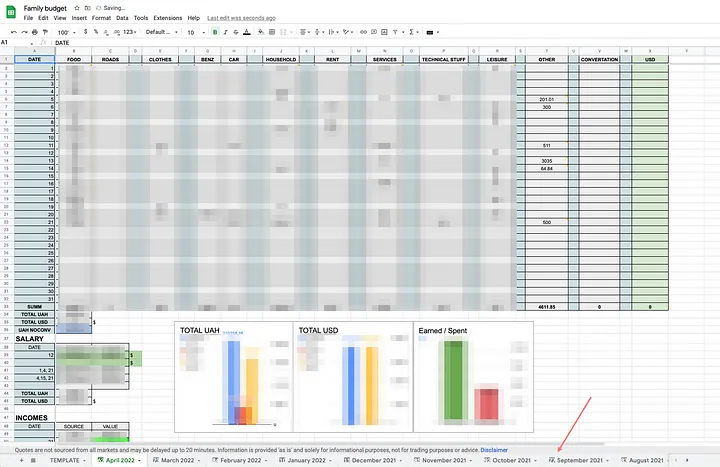
Google Sheets works because it gives a family one visible shared document. But it still feels like an accounting surface rather than a natural place for fast daily input.
For collaborative budgeting, the question is not only whether everyone can see the data. It is whether everyone will actually add to it.
Why Telegram became the interface
For my own case, Telegram was the natural choice. I live in Ukraine, where Telegram is a routine messenger for many people, so the interface was already familiar and always available.
That changes the equation. Instead of asking family members to adopt a new finance app, I can place the budget tool inside the communication channel they already use every day.
The advantage is not that Telegram is a perfect finance platform. The advantage is that it is already a shared habit.
The project is here:
What the bot is meant to provide
The bot is a self-hosted family budgeting interface rather than a fully automated financial platform.
Its intended advantages are:
- no extra consumer app to install
- one shared entry point for all participants
- data hosted under your own control
- simple entry flow inside a familiar messenger
- configurable interface
- monthly and annual analytics
- access control for users
- Docker-based deployment
The corresponding costs are also real:
- setup requires technical confidence
- hosting is not free
- maintenance does not disappear after launch
This is why I see it as a personal collaboration tool for a household rather than as a general-purpose finance product.
Design perspective
The interesting part of the project is not the bot itself. It is the interface choice behind it.
A family budgeting tool does not need to be impressive. It needs to be shared, understandable, and easy to update in the moment when money changes hands. In that sense, the bot is an interface optimization: it places budget capture inside the communication tool that already coordinates family life.
Summary
The core problem of family budgeting is not analytics. It is maintaining one shared record that people actually update.
If a household already lives inside a shared messenger, then a budgeting bot can be a reasonable alternative to spreadsheets and dedicated finance apps. It reduces switching costs, gives all participants one collaboration surface, and keeps control over the data closer to the family itself.
Recommendations
- choose the tool that makes contribution easy for every participant
- prefer one shared record over parallel private logs
- evaluate tools by collaboration quality, not only by analytics depth
- use spreadsheets when shared visibility matters more than entry speed
- use a self-hosted bot only if setup and maintenance are acceptable household costs
The best family budgeting tool is usually the one that everybody can update before forgetting what the expense was for.